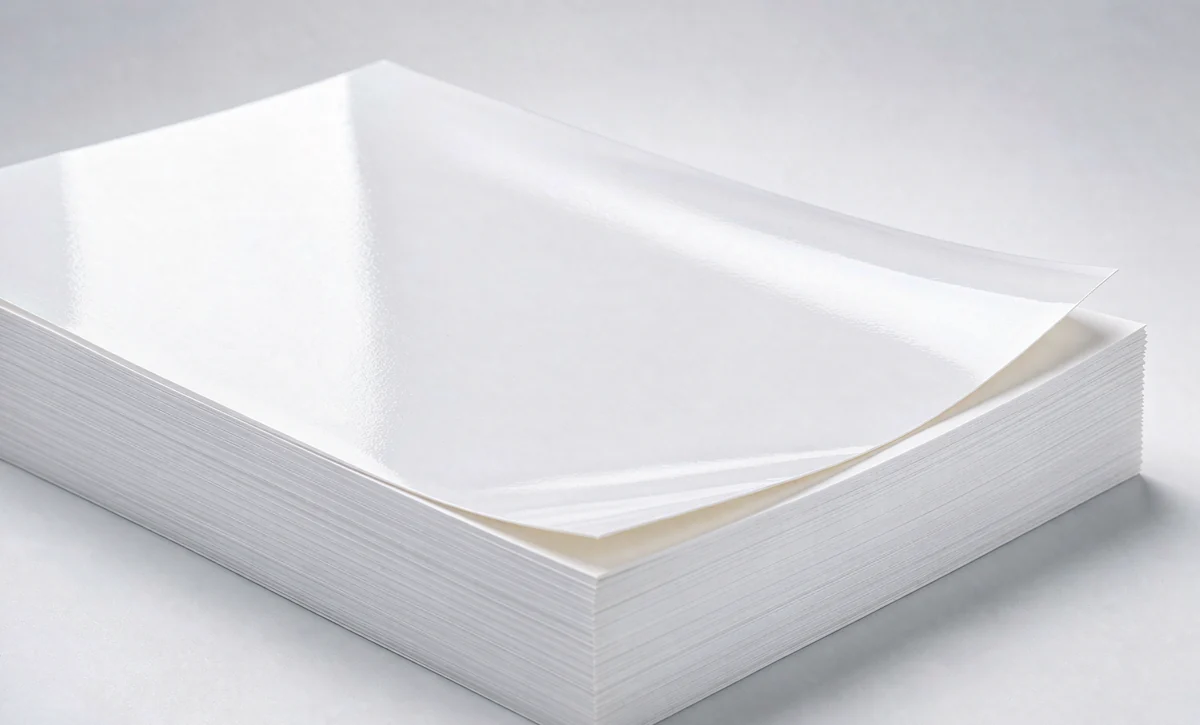
Cast coated paper is a coated printing paper that is dried against a heated, mirror-polished steel drum, which transfers a glass-like finish to the coating surface. The result is the glossiest and smoothest paper available in commercial quantities, with surface characteristics that ordinary coated art paper cannot match. For label printers, cosmetics brands and premium packaging converters, cast coated paper is often the difference between a product that looks expensive and one that looks ordinary.
This guide explains what cast coated paper is, how it is made, which grades exist and how to specify it correctly for your application.
What is cast coated paper?
Cast coated paper belongs to the coated paper family. Like all coated grades, it starts with a base sheet of woodfree (mechanical-free) paper that is then coated with a mineral layer containing china clay (kaolin), calcium carbonate and synthetic binders. What makes cast coated paper unique is the drying stage: while the coating is still wet and plastic, the paper web is pressed against a heated chromium-plated drum polished to a mirror finish.
As the web dries in contact with that drum, the coating surface takes on an exact impression of the polished metal. The coating flows flat before it hardens, so no amount of pressure applied later can reproduce the same effect. The outcome is a surface with extremely low roughness, very high gloss and outstanding ink holdout.
Key properties of cast coated paper
Buyers typically evaluate cast coated paper on the following properties:
- Gloss. High-gloss cast coated grades commonly reach 80 to 95 gloss units measured at 75 degrees, well above standard coated art paper. Matte and satin cast variants sit lower, around 20 to 45 gloss units, while keeping the same smoothness.
- Smoothness. The cast surface is measurably smoother than calendered coated paper. This matters most for fine halftone screens and small type, where surface roughness would otherwise break up the ink film.
- Brightness and whiteness. Optical brightening agents and high-grade pigments push ISO brightness into the low-to-mid 90s on premium grades, giving colours a clean, neutral white background.
- Ink holdout. Because the coating is dense and non-absorbent, ink stays on the surface instead of soaking in. That produces higher printed ink density, sharper dots and more consistent colour from sheet to sheet.
- Dimensional stability. A stable base sheet and controlled moisture content help the web run cleanly on high-speed presses and label converters.
Cast coated paper vs. coated art paper
Both are coated woodfree papers, but they serve different jobs:
Surface and print result
Coated art paper is dried on conventional dryers and finished with calenders, so its surface is smooth but still slightly uneven. Cast coated paper is imprinted by a polished drum, giving a surface closer to glass. For fine line work, metallic inks and photographic reproduction, cast coated paper reproduces detail that art paper loses.
Converting and end use
Art paper dominates brochures, magazines and general commercial printing where cost per impression matters. Cast coated paper dominates applications where the printed surface itself is part of the product's perceived value: wine and spirits labels, cosmetics cartons, greeting cards, book covers and premium point-of-sale material.
Cost
Cast coated paper carries a price premium because the casting section is capital intensive and runs at lower speed than a standard coater. The premium is justified when print impact, not paper cost alone, drives the buying decision.
Common grades and applications
Cast coated paper is usually specified by grammage and finish:
- High-gloss cast coated, 80 to 115 gsm. The workhorse of the self-adhesive label industry, especially for wine, beverage, food and personal care labels printed by UV flexo, offset or letterpress.
- Matte or satin cast coated, 80 to 120 gsm. Chosen when a soft, premium look is preferred over mirror gloss, common in pharmaceutical labels and luxury packaging.
- Cast coated folding boxboard, 180 to 300 gsm. Used for cosmetic cartons, pharma packaging and confectionery boxes that need stiffness plus a coated printable face.
- Cast coated publication grades, 70 to 100 gsm. Used for art books, annual reports and high-end covers where image reproduction is critical.
How to specify cast coated paper
When requesting a quotation, give your supplier the following information. It removes ambiguity and prevents claims later:
- Grammage and tolerance (for example 80 gsm plus or minus 2 gsm).
- Finish: high gloss, satin or matte, with the gloss range you expect.
- Brightness target and shade (blue-white or neutral white).
- Roll or sheet format, reel width and core size if you run a web press.
- Printing process and ink system, because surface sizing for toner-based digital printing differs from offset or UV flexo.
- Any certification you need, such as FSC or a declared recycled content level.
At China UV Paper we produce cast coated and coated woodfree grades on a 6,600 mm wire, with quality control covering brightness, gloss, smoothness, basis weight and moisture on every reel. If you are evaluating cast coated paper for a new label or packaging project, our technical team can help you match the grade to your press and ink system before you commit to a trial run.
Evaluating cast coated paper for a label or packaging project?
Contact our technical team for samples, data sheets and grammage recommendations.
Frequently asked questions
Q: What is cast coated paper used for?
A: Cast coated paper is used for premium labels (wine, spirits, cosmetics, pharma), luxury folding cartons, greeting cards, book covers and high-end brochures, wherever a glass-smooth, high-gloss printed surface is needed.
Q: Is cast coated paper the same as art paper?
A: No. Art paper is coated and calendered; cast coated paper is coated and dried against a heated mirror-polished drum, which produces a much smoother and glossier surface.
Q: Can you print cast coated paper on an offset press?
A: Yes. Cast coated paper prints well by offset, UV flexo, letterpress and screen. For toner-based digital printing, request a digitally surface-sized grade, because standard cast coated paper is not optimised for fusing heat and toner adhesion.
Q: What grammage is best for wine labels?
A: Most wine labels use 80 to 90 gsm high-gloss cast coated paper as the face stock, laminated to a release liner. The exact choice depends on the bottle shape, application method and whether the label must survive ice-bucket immersion.
Q: Does cast coated paper have high recycled content?
A: It can. Cast coated grades are produced on virgin pulp and on recovered-fibre base sheets. At China UV Paper, recycled fibre streams are used where the grade and food-contact rules allow it, and the content level is declared per order.